Teaching Portfolio.
Industry Collaboration with AKG – Anadolu Kültürel Girişimcilik
THE NEW OLDS: Designing Cultural Artefacts, 2019–2020, Third Year Design Studio, Kadir Has University, Department of Industrial Design
Culture consists of learned patterns of thought and behaviour that are characteristic of a particular community. Culture includes beliefs, values, language, political organisation and economic activity, also technology, art and material culture. A commodity is an item that can be freely bought and sold through the market economy. All commodities (even raw materials) are cultural artefacts in the sense that demand for them is culturally constructed.
The Object and its value
Along with the earliest examples of artefacts, the value attached to the objects has demonstrated a complex system. Every object-artefact conveys a system of values within. Some values are derived from the intrinsic properties, whereas some are subjective.
Anthropologically, economic change creates value, and that value is embodied in commodities that are exchanged. For each object, be it a crafted artefact or an industrially manufactured good, alongside its value as a commodity there exist moral or aesthetic values which operate, for their part, in terms of a set opposition between good and bad, between beautiful and ugly (Baudrillard, 2003, p.10).
The object as a souvenir
Along with the earliest examples of artefacts, the value attached to the objects has demonstrated a complex system. Every object-artefact conveys a system of values within. Some values are derived from the intrinsic properties, whereas some are subjective.
The value of any object/artefact as a souvenir emerges solely by personal association independent of the intrinsic value of the object. Such a personally held value may not be recognizable by others and is akin to that of family heirlooms, where memories external to the object’s design produce value that transcends the monetary (Parsons, 2009, p.29). Apart from the fact that they can be consumed as a memento of the touristic experience, they convey a high sign value in relation to their uniqueness and design qualities in parallel to their genuine heritage value.
Design Brief
“Anadolu Kültür Girişimcilik A.Ş. (AKG), is established under DETUR within the scope of Turkey's tourism and cultural promotion. In Turkey museums operate under the Ministry of Culture and Tourism and AKG having the authority to operate the commercial area of the ruins, the protection of Turkey's cultural and historical heritage, providing resources for maintaining and promotion. It creates special product collections with special illustration works for 13 the region, museum or ruins in the museum stores where we operate and offers service to museum lovers with its replica and wide product range. In our museum stores, there are design replicas, decorative objects, t-shirts, bags, jewellery, mugs, hobby products, souvenirs created by inspiring from the museum collection, ruins and works exhibited.
Our target is to support the preservation and survival of our cultural heritage. Being a cultural ambassador with contemporary museum retailing service. Providing unforgettable opportunities for local and foreign tourists in museum experiences. Presenting cultural products to museum lovers with unique designs and visuals. To present an unforgettable cultural feast to local and foreign tourists by telling the stories of the products. Offering value-added products with a story that complement and enrich the museum experience.”
Topics to be explored are as follows:
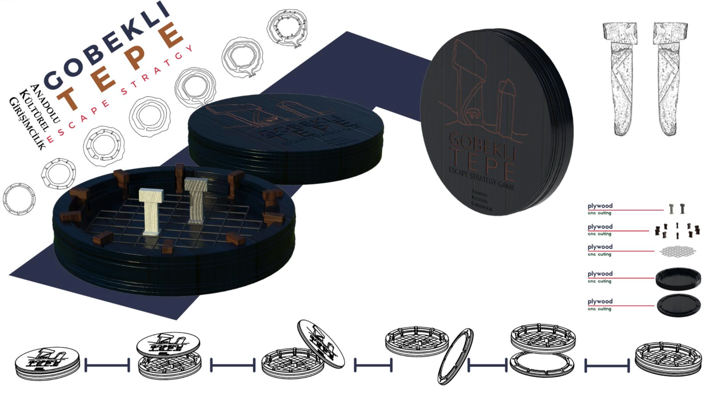
▪ The forgotten games: all games which have diminished over time, reviving them with a contemporary function
▪ Tavla (Backgammon); the new portable tavla for kids and adults, innovative solutions compatible with cultural values
▪ Packaging Design: Innovative, producible packaging designs for product sets for gastronomical experiences
▪ Desktop Accessories; functional and aesthetic gift product group (including lighting, add-ons etc.) (It is recommended to develop products for Topkapı Palace, Ephesus, Pamukkale, Göreme Ruins for this group)
Issues to be considered in design solutions;
▪ New contemporary design strategies,
▪ New product and corporate identity language,
▪ Production and cost planning,
▪ Development of suggestions by evaluating aesthetics, function and packaging together,
▪ Developing a product that integrates the experience of visitors in museums and ruins and identifies with the Anatolian cultural and historical heritage,
▪ Consisting of various colours and